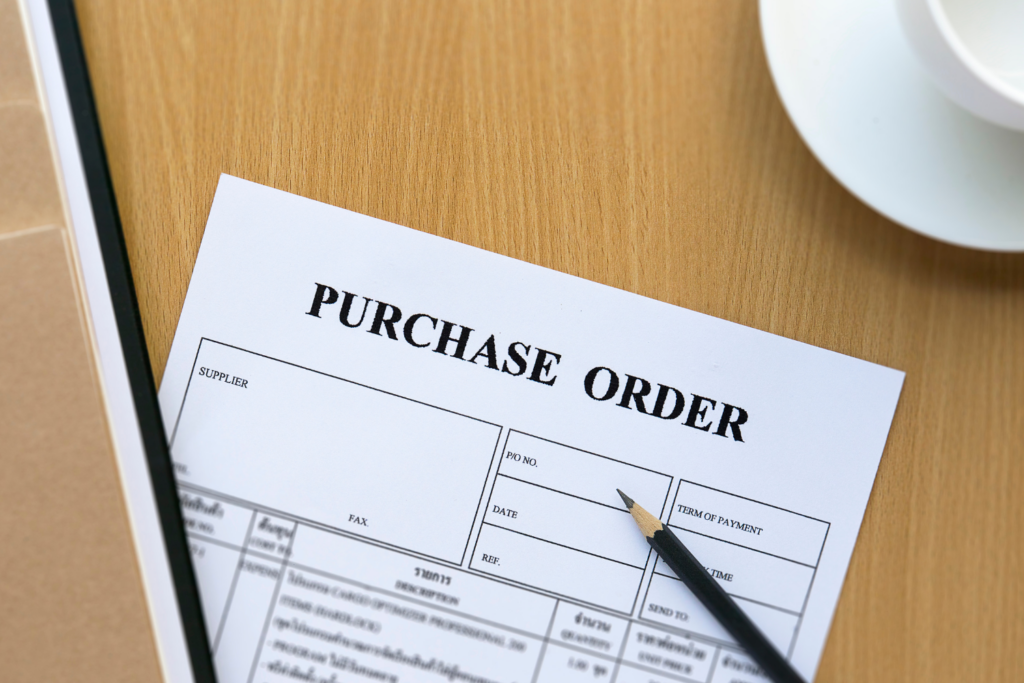

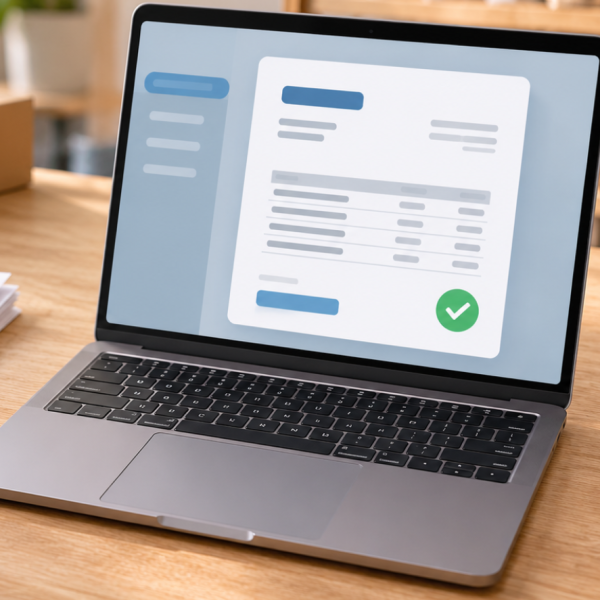
Whether on paper or in digital form, an invoice documents your sales and provides an important basis for your accounting. As a retailer, you must ensure that your invoices contain the required information and are properly retained.
Here, you can find out which rules apply, how to use Letzshop’s free invoicing feature and what changes are planned with the introduction of e-invoicing.

The traditional paper invoice
An invoice can generally be issued on paper and given to the customer with the goods, for example, or sent by post. The customer receives one copy, while you retain another for your accounting records.
The invoice must clearly document the sale and contain the information required in each case. These requirements depend, among other things, on your legal form, your VAT status and the transaction concerned.
What information must an invoice contain, regardless of its format?
Your business details
These include, in particular:
- Your name or business name and full address;
- Legal form, where applicable;
- Your LBR registration number, where applicable;
- Business permit number, where required;
- For craftspeople and traders operating in their own name, their professional designation, where applicable;
- Your VAT identification number, where applicable.
Invoice and delivery details
The invoice must be uniquely identifiable. This requires:
- The date of issue;
- A unique sequential invoice number, where appropriate within several numbering series;
- The delivery or service date, or the date of the advance payment, where this is known and differs from the invoice date.
Customer details
The full name and address must be provided, particularly for taxable customers and non-taxable legal entities.
The customer’s VAT identification number is required, in particular, for certain intra-Community B2B transactions. In general, your customer invoices should clearly identify the customer concerned.
Product, price and VAT details
The invoice must clearly document the sale being invoiced. This includes:
- The type and quantity of goods supplied, or the nature and scope of the service;
- Prices excluding VAT and other elements of the taxable amount, taking discounts into account;
- The VAT rates applied and VAT amounts, shown separately where several rates apply;
- A clearly identifiable total amount.
If no VAT is charged, the reason for the exemption must be stated. Depending on the transaction, additional wording may be required, such as “Reverse charge” where the customer is liable for the VAT.
The order number, payment method, payment status and, where applicable, payment deadline and bank details are also useful. These practical details should be distinguished from the legally required information.
Are simplified invoices allowed?
For a total amount of no more than €100 including VAT, a simplified invoice is possible, provided the transaction does not involve another EU Member State.
It contains:
- The date of issue;
- The seller’s name and address;
- The type and quantity of goods, or the nature and scope of the service;
- The price including VAT;
- The VAT amount or the information needed to calculate it.
Any other applicable business disclosure requirements must still be observed.
When must the invoice be issued?
For transactions between businesses, the invoice must generally be issued no later than the 15th day of the month following the delivery or service. Special rules apply to advance payments and recurring invoicing.
Further information is available on Guichet.lu and the Indirect Tax Portal.
How long must invoices be retained?
As a general rule, retain issued and received invoices, corrections and credit notes for ten years.
Two requirements must be considered when calculating this period:
- Under VAT law, the ten-year retention period for invoices starts on their date of issue.
- Under commercial law, accounting records must be retained for ten years from the end of the financial year concerned.
Take both requirements into account when organising your records.
How must invoices be archived?
Invoices can be retained on paper or electronically. Authenticity of origin, integrity of content and legibility must be ensured throughout the retention period. Additional requirements apply when records are stored abroad.
Download digital invoices regularly and save them in your own filing system, with an additional backup copy. Ensure that you can still access them if you change your software or close your storefront.
How should errors, returns or refunds be documented?
If an invoice has already been issued, errors, returns or subsequent discounts should be corrected in a traceable manner.
Retain the original document and, depending on the circumstances, issue a corrective invoice or credit note that clearly refers to the original invoice and identifies the changes.
A refund and an accounting correction are two separate steps. When cancelling an order or issuing a refund, therefore, also check whether the corresponding invoice needs to be corrected and send the relevant document to the customer.
Sending invoices by email
In addition to paper invoices, invoices can generally be sent electronically, for example as a PDF by email, provided the recipient agrees.
Digitally sent invoices must also contain all the required information. Sending an invoice by email does not change your retention obligations.
Letzshop’s free invoicing feature
As a Letzshop retailer, you can use our free automatic invoicing feature.
Once it has been activated for your storefront, an invoice is automatically generated and emailed to the customer when you confirm an order.
You can view the invoices generated in the shop management interface under “Invoices”, in the “Edit” section. The “Received” section, on the other hand, contains the statements relating to the Letzshop fees charged.
Would you like to use automatic invoicing? Contact our team at support@letzshop.lu.
Please check your business details and the VAT rates entered for your products. As the seller, you remain responsible for the correct tax treatment and your invoices.
Which VAT rates does the feature use?
The automatic invoicing feature uses the VAT rates entered for Luxembourg.
Only one VAT rate can be defined per product. Automatic adjustment to the delivery country is not possible. This also applies if a rate of 0% has been entered for an item. Such an entry does not replace the need to check the applicable tax regime and the wording required on the invoice.
Example: An item is subject to 17% VAT in Luxembourg and 19% VAT in Germany. If 17% is entered for the product, the feature will also generate an invoice with 17% VAT when the item is delivered to Germany.
If German VAT must be charged on this sale, the automatic Letzshop invoice is not suitable for it.
When can Luxembourg VAT be charged on deliveries to other EU countries?
Luxembourg VAT may continue to apply to certain deliveries to private customers in other EU countries.
To qualify for the €10,000 exception, the retailer must generally be established only in Luxembourg and dispatch the goods from Luxembourg. The relevant turnover must not exceed €10,000 excluding VAT in either the current or the preceding calendar year.
The following rules apply:
- The threshold covers the combined total of the relevant intra-Community distance sales and certain electronic, telecommunications and broadcasting services.
- It applies across the EU and across all sales channels, including sales outside Letzshop.
- If the retailer has voluntarily opted for taxation in the country of destination, the exception does not apply.
- If the threshold is exceeded, the destination principle applies from the transaction that causes the threshold to be exceeded.
Special cases must be assessed separately.
For our example, this means: If the retailer may legally charge the German private customer 17% Luxembourg VAT, the automatic invoicing feature can generally be used. If 19% German VAT applies, the retailer must use another invoicing solution. Where applicable, foreign VAT can be declared through the One Stop Shop (OSS). Further information is available on the European Commission’s website.
Contact us in good time if you need to apply foreign VAT rates, so that automatic invoicing for your storefront can be reviewed and, if necessary, deactivated. Discuss the tax treatment with your accountant.

Upcoming e-invoicing in Luxembourg
Luxembourg plans to extend mandatory electronic invoicing to domestic business transactions between companies established in Luxembourg. This is based on Draft Law No. 8815.
Under the proposed timetable, all Luxembourg companies must be able to receive and process electronic invoices from 1 January 2028. Subsequently, large and medium-sized companies must issue and transmit electronic invoices from 1 July 2028. In the final phase, the obligation to issue electronic invoices will be extended to the remaining companies from 1 January 2029.
How does an e-invoice differ from a PDF invoice?
A structured e-invoice contains standardised data that accounting software can read and process automatically.
An ordinary PDF or a scan sent by email does not, on its own, meet this requirement. The Peppol network, which is already used in the public sector, is envisaged in particular for exchanging these invoices.
Likewise, automatically emailing an invoice through Letzshop does not, by itself, demonstrate compliance with the upcoming requirements for structured e-invoices.
These dates are subject to the final legislation. The planned extension concerns transactions between businesses, meaning the B2B sector. It does not create a general obligation to send a structured e-invoice to every private Letzshop customer. Separate electronic invoicing obligations already apply to public procurement and concession contracts.
How can you prepare?
Discuss with your accountant and software provider well in advance how you will receive, issue and archive structured e-invoices in the future.
Also consider retention: the associated structured data must be preserved. A printout alone is not an adequate archiving strategy for a structured e-invoice.
Up-to-date information on the proposed legislation is available on the official E-facturation Luxembourg portal.
Legal information as of 10 November 2026. This article provides a general overview. For the tax treatment of your business and specific transactions, please contact your accountant or the relevant authority.
Simplify your day-to-day business with Letzshop
Would you like to spend less time on invoicing and more time on your business? With Letzshop’s free automatic invoicing feature, your customers receive their invoice directly by email as soon as you confirm the order.
Already selling on Letzshop and interested in using the feature? Contact us at support@letzshop.lu. Together, we will check whether the feature meets your needs.
Would you also like to make your business visible online? Join the Letzshop community and reach new customers in Luxembourg.
Please note: This article provides general information for professional retailers in Luxembourg and does not constitute individual legal advice. It was created with the assistance of artificial intelligence (AI) and editorially revised.